Commentary: PSLE scores could impact life outcomes. So don’t let them
SINGAPORE: Concluding month, the Primary Schoolhouse Leaving Examination (PSLE) results were released.
Every yr, right around the time this happens, we oft see people sharing stories on social or traditional media about how they didn't quite do so well in the PSLE simply notwithstanding attained success in life.
Flick-maker Royston Tan, for case, has notably shared that he scored 168 for the exam, placing him in the normal stream. Today, however, he is a historic film-maker.
"Y'all just have to give your best in whatever you do and believe that the dots will connect in the future", he said in 2018.
Often, these stories go viral because of the feel-skilful vibes they create. The chief message from these stories seems to exist: Don't take the PSLE scores too seriously. They do not define you lot.
Still these stories would be challenged by netizens and criticised for existence insensitive anecdotes which lack generalisability.
READ: Commentary: PSLE scores and the problem with the beloved late bloomer narrative
READ: Commentary: Life Beyond Grades a worthy cause but exist conscientious not to trivialise failure
NOBODY KNOWS HOW MUCH IMPACT A DIFFERENT PSLE SCORE MIGHT Accept HAD ON You
How Singaporeans have learnt to cope with this high-stakes exam has evolved over many years. In particular, there is a growing realisation that while grades shouldn't ascertain us, they do shape subsequent pathways.
One reason why PSLE scores notwithstanding receive attention is because they practice determine your form of study in secondary school. Less ideal grades may mean being tracked to a less demanding stream.
This could change life outcomes since the type of education received (whether academic or vocational) and the peers ane volition encounter are different.
How dissimilar would your life be had you been tracked into a different stream? The people sharing their stories seem to argue it did non matter much, because despite doing badly in the PSLE and being tracked into a less demanding stream, they ended up in a well-paying job anyway.
But frankly, no one knows. You volition never know what lies at the end of the road not taken.
Perchance you lot might have enjoyed an even ameliorate job had y'all gone to a more demanding stream? Perhaps y'all might have encountered vastly unlike connections that would have led to down some other career path?
WHY COMPARING OUTCOMES ACROSS STREAM IS PROBLEMATIC
Netizens often suggest that one manner to tell if streaming has had an effect is to compare the outcomes of people who studied in different streams. For instance, compare the salaries of graduates from the limited stream to those from the normal (academic) stream.
READ: Commentary: Streaming out. Field of study-based banding in. How are parents reacting?
However, such comparisons are unlikely to reliably capture the result of streaming. Graduates from the express and the normal streams are not the same to begin with.
They may differ, on average, in aspects similar family unit income, parental pedagogy, innate ability, and more than.
Consequently, part or even all of the difference in bacon may be reflecting differences in these attributes, rather than the effect of streaming.
A more reliable approach to tell if streaming has made a difference would exist to utilise what economists call a regression discontinuity design. This approach compares people who autumn narrowly on both sides of some PSLE score which determines stream status.
For instance, suppose that students would qualify for the express stream only if they scored in a higher place or equal to a cut-off similar 188 for the PSLE.
If then, nosotros tin compare the salaries of people who narrowly scored higher up 188 (so managed to get into the limited stream) to those who narrowly scored below (and so failed to get into the limited stream).
READ: Commentary: We have totally undervalued tardily bloomers
Since people immediately on both sides of this fence are likely to be similar on average, whatsoever difference in salaries would be capturing the impact of being tracked into a different stream.
Such a study has nevertheless been done in Singapore due to the lack of publicly available data. But there is value in pursuing it because information technology allows u.s.a. to amend understand the consequences of streaming and power-based group in general.
Simply Subject area-BASED BANDING MAY CHANGE THAT
Such an practice might take been overtaken by events given that Singapore volition from 2024 be entering a new era where streaming will be replaced by bailiwick-based banding (SBB).
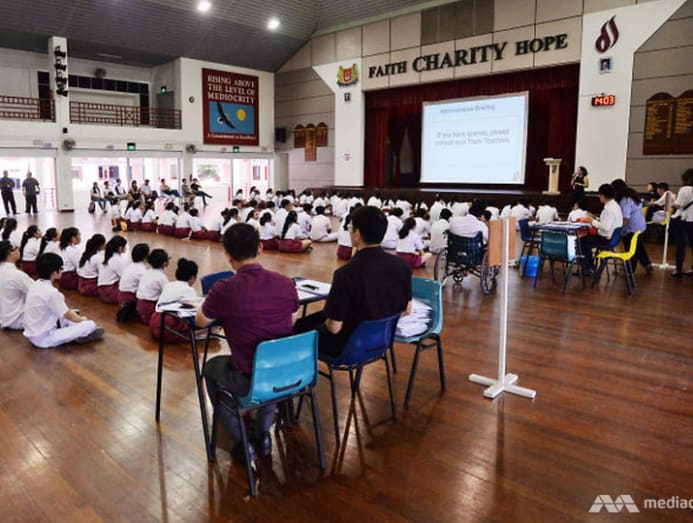
Ane of the greatest merits of SBB is it retains the benefits of customised education - past ensuring students receive instruction in specific academic subjects tailored to their learning needs - still avoids the labels accompanying beingness tracked into a less demanding stream.
Labels are harder to ascribe nether SBB since, in theory, each educatee can pursue each field of study at a pace which is either more or less demanding.
READ: Commentary: These PSLE changes won't fix our national obsession with academic accomplishment
READ: Commentary: What we gain and lose in moving away from streaming
Information technology besides opens upwardly the possibility of greater social mixing betwixt students of different abilities since students are no longer grouped into self-independent classes based on their overall previous academic achievement across all subjects. Instead, they attend dissimilar classes for various subjects based on their specific subject power.
Schools can also organise students into mixed form classes for mutual curriculum subjects like art. Each form would then comprise a mixture of students with different abilities.
ENSURING PATHWAYS REMAIN POROUS
Of course, the merely exception is if a educatee takes all of his academic subjects at a less enervating level and face inevitable invidious comparisons with his peers.
For such a educatee, his received secondary school teaching could still limit his progression since taking all subjects at, say, the to the lowest degree-demanding level (i.east. G1 level) could ultimately leave him or her unprepared to take on an academically-oriented mail-secondary pedagogy.

Such a student must be willing to take a less direct route (for case, going from an ITE to a polytechnic before becoming eligible for university) – which could be long and backbreaking – to overcome that and eventually be placed into an bookish track. This may deter many.
That is not to say that all students should be allowed to access an academically-oriented mail service-secondary education. Some students will naturally be less suited for such a track.
Rather, information technology says that pathways must remain open and porous with criteria for entry into university sufficiently various to ensure secondary schoolhouse accomplishment doesn't become an obstacle for students who should exist admitted.
Fifty-fifty then, such a pupil with an unconventional educational background could go on to exist labelled and stigmatised.
READ: Commentary: The relentless pursuit of university rankings is creating a ii-track system
MAKING SBB FLUID
As nosotros move towards SBB, standing to find ways to keep pathways flexible and open volition be central to ensure nosotros do not close off life opportunities for belatedly bloomers.
I mode to do this is to make the "promotion process" simpler and remove obstacles teachers face in trying to promote students to read subjects at more than demanding levels every bit students' abilities improve.
In particular, requirements for teachers to write lengthy reports justifying why a student should be "promoted" should exist avoided because this creates incentives for teachers to maintain the status quo.
READ: Commentary: Teachers now have new jobs. Schools will never be normal again subsequently COVID-19
Further, flexibility should be built into the organisation and then that students will exist able to be identified for "promotion" any time during the school year as long every bit he/she is fix and school resources permit.
This volition enable students to transit into the new curriculum more than quickly instead of having to look for pre-specified junctures, equally has been proposed.
These could aid to accomplish the policy intent of SBB improve and minimise its downsides.
While SBB will make PSLE scores less of a brand-or-interruption, the system has room for comeback to ensure that education will exist an enabler, non a stumbling block.
Listen to three working adults reveal how their PSLE results have shaped their life journeys in a no-holds barred conversation on our Heart of the Affair podcast:
Kelvin Seah Kah Cheng is a Senior Lecturer in the Department of Economics, National University of Singapore and a Research Affiliate at the Constitute of Labor Economics (IZA).
spencerthersenight.blogspot.com
Source: https://cnalifestyle.channelnewsasia.com/commentary/commentary-psle-scores-could-impact-life-outcomes-so-dont-let-them-277506
0 Response to "Commentary: PSLE scores could impact life outcomes. So don’t let them"
Post a Comment